For an established product brand entering Europe, the useful question is not simply which marketplace is biggest. It is which country, platform and operating model give your product a credible route to profitable customers.
Amazon, bol, Allegro and Digitec Galaxus belong in that discussion. Their relevance varies by country, but a popularity map cannot tell you whether your product will sell, whether you can join the platform or what you will earn after fulfilment, promotion and returns.
I use this kind of data to build a shortlist. I then work back to the product, the commercial terms and who will manage the market after launch. That applies whether the team is overseas or already has a UK-based representative coordinating European expansion.
Research checked 30 October 2026. Financial figures below refer to 2025 unless marked as forecasts. This guide covers all 15 countries in DHL’s European platform comparison, with separate Nordic context. It is not an exhaustive platform ranking.
Which marketplaces are popular in different European countries?
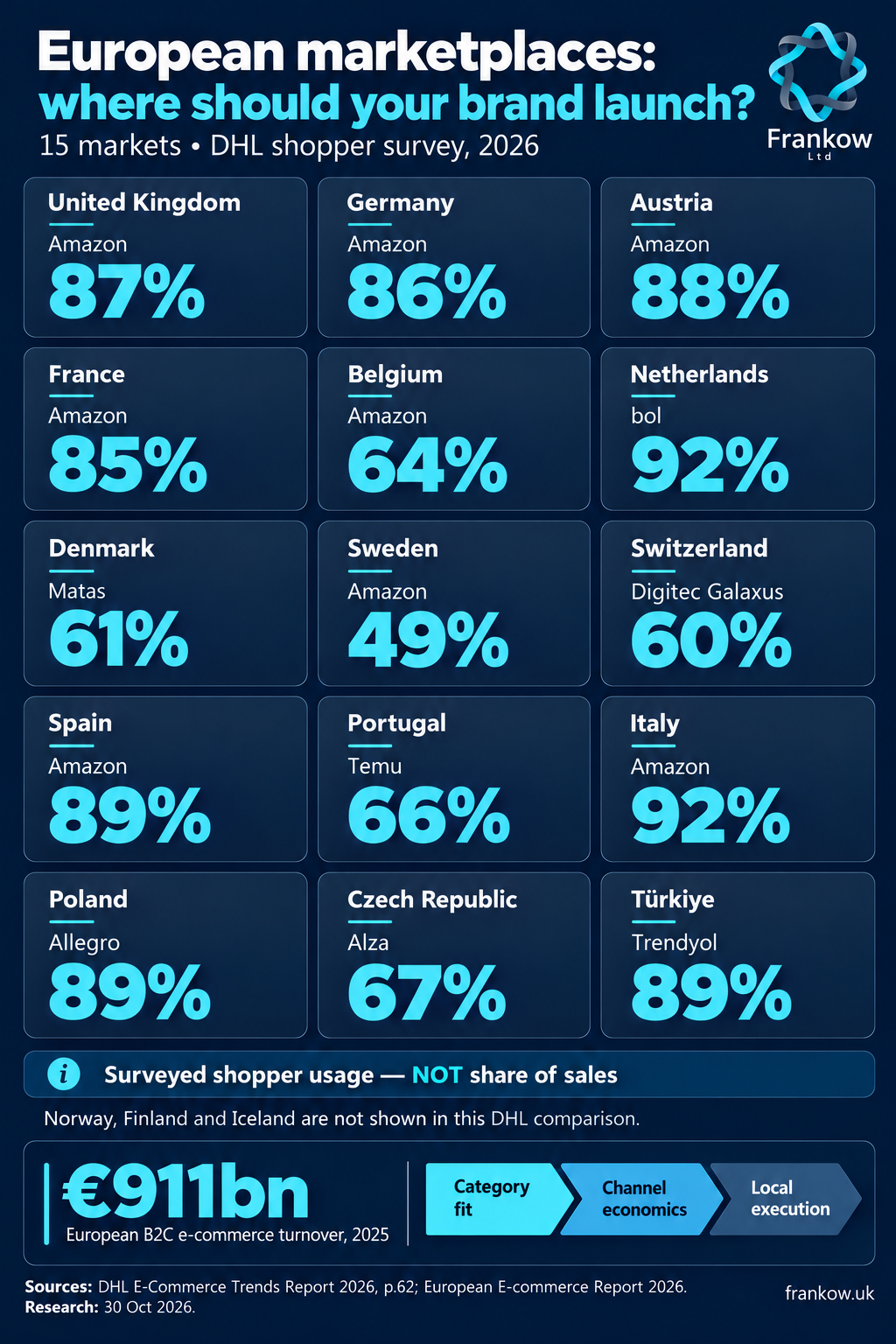
DHL’s 2026 report identifies the following leading platforms among surveyed shoppers in its 15-country European comparison. These percentages describe shopper usage, not share of sales, order volume or exclusive loyalty.
| Country | Platform shown by DHL | Shopper usage |
|---|---|---|
| United Kingdom | Amazon | 87% |
| Germany | Amazon | 86% |
| Austria | Amazon | 88% |
| France | Amazon | 85% |
| Belgium | Amazon | 64% |
| Netherlands | bol | 92% |
| Denmark | Matas | 61% |
| Sweden | Amazon | 49% |
| Switzerland | Digitec Galaxus | 60% |
| Spain | Amazon | 89% |
| Portugal | Temu | 66% |
| Italy | Amazon | 92% |
| Poland | Allegro | 89% |
| Czech Republic | Alza | 67% |
| Türkiye | Trendyol | 89% |
Source: DHL E-Commerce Trends Report 2026, page 62. The report presents shopper and business figures separately; this table uses the shopper figures.
DHL’s fieldwork ran from 15 December 2025 to 11 February 2026, with shopper respondents required to have purchased online within the preceding three months. This is survey evidence, not an audited transaction dataset. Survey methodology
Even if you already sell on Amazon, I would research the local competition before taking the same range into another country.
What about Norway, Finland and the wider Nordics?
Norway, Finland and Iceland are not shown in DHL’s European platform comparison above. Their absence is a coverage gap, not evidence of low demand.
For wider Nordic context, PostNord’s E-commerce in the Nordics, Spring 2026 surveyed 4,000 people aged 18–79 across Sweden, Denmark, Finland and Norway in January–February 2026. It reports the following shares who had shopped online during the previous 30 days:
| Country | Shopped online in the previous 30 days |
|---|---|
| Sweden | 88% |
| Denmark | 85% |
| Finland | 84% |
| Norway | 86% |
Source: PostNord, Spring 2026, methodology and key-metrics table. These measure recent online shopping, not use of a particular marketplace, and must not be ranked against DHL’s percentages. Iceland is outside this four-country study.
My starting point would be a separate category shortlist for each Nordic country. For Denmark, Matas’s beauty-and-wellbeing focus illustrates why the leading name in a broad survey may be irrelevant to a connected-device brand. In Finland and Norway, I would check suitable local retailers and platforms, customer support and delivery requirements before choosing the first route. I would not copy the Swedish shortlist and assume it covers the region.
How large is European e-commerce?
The 2026 European E-commerce Report puts 2025 European B2C e-commerce turnover at €911 billion, across 38 countries. Its €961 billion figure for 2026 is a forecast, not a completed-year result. Western Europe accounts for 57% of the 2025 total. EuroCommerce and Ecommerce Europe report
These figures describe the broad B2C e-commerce economy. They are not Amazon sales, marketplace-only turnover, or the addressable market for a particular electronics product.
I would use the regional scale to set context, then narrow the research to the category and price band. A smaller country with suitable customers and manageable support requirements can be a better first test than a larger market that stretches the team too far.
Platform volume: what the financial figures actually tell you
Allegro and Digitec Galaxus publish figures that help put their scale in context.
| Platform | Reported scale | What the figure covers |
|---|---|---|
| Allegro | Nearly PLN70 billion GMV in 2025 | Group gross merchandise value; not platform revenue or Poland-only sales. The company separately reports 9.4% full-year Polish GMV growth. |
| Digitec Galaxus | CHF3.764 billion platform sales in 2025; five million shoppers during the year | Switzerland and EU business combined. Platform sales include its own sales and marketplace activity, with other components; not Swiss-only third-party seller turnover. |
Sources: Allegro’s 2025 results announcement and Digitec Galaxus’s 2025 results and metric definition.
For your launch budget, the useful number is what you can sell in your category and what remains after costs.
To estimate realistic launch volume, I would look for category-level evidence: competing products, achievable pricing, customer questions, delivery expectations and the cost of acquiring an order. Where reliable unit-sales data is unavailable, I would record an assumption and test it rather than present a forecast as fact.
How I would shortlist countries and platforms
I would prepare one page for each serious candidate, covering the same five decisions.
| Decision | Evidence I want before committing |
|---|---|
| Category fit | Comparable products, price bands, review themes and a clear reason to choose this product |
| Access | Current seller or supplier eligibility, category acceptance and the right commercial route |
| Economics | Contribution after product cost, fees, fulfilment, returns, promotion and support |
| Execution | Named owners for stock, local content, customer questions, replenishment and returns |
| Channel development | How marketplace pricing and availability fit later distributor or retail plans |
Amazon-led candidates: I would compare countries separately rather than copy the same commercial assumptions into every store. Amazon provides a global-selling route, but account access is only one part of operating locally.
The Netherlands: bol deserves investigation where the category fits. Its official onboarding guidance separates businesses in the Netherlands or Belgium, elsewhere in Europe and outside Europe. I would confirm the applicable route before budgeting for a launch. bol seller guidance
Spain and Portugal: I would research them separately. The different platforms shown in the table are a prompt to investigate the category, price positioning and available seller routes. A premium product needs a reason to buy beyond a low headline price, wherever it is listed.
Belgium and Austria: I would test whether an adjacent-market operation can genuinely support local customers. Shared language or proximity can help, but stock availability, service and the commercial owner still need to be defined.
Türkiye: I would establish the local commercial route and operating requirements before treating it as an extension of another European launch. The survey’s platform result supplies a research starting point, not confirmation of seller eligibility.
Poland: Allegro belongs on the research shortlist. I would examine the actual category offer, customer-facing delivery proposition and promotional economics before deciding how much stock to allocate.
DACH: I would compare Germany, Austria and Switzerland as distinct commercial plans. Shared language can help preparation, but it does not make pricing, fulfilment, seller access and customer support identical. The shortlist should reflect the country the brand can serve well, not simply a regional label.
For the broader choice between direct retail, a distributor and marketplace selling, see how I choose a UK market-entry route. This guide addresses the next question: which country/platform combination deserves a test?
A useful pilot measures contribution and customer questions
Imagine an established connected-device brand considering two European countries. This is an illustrative planning example, not a client result.
I would start with a limited product range and a defined stock commitment. Before launch, the team would agree what it needs to learn and what would stop further investment.
The weekly review would cover:
- Orders and contribution after the full variable cost of selling.
- Advertising spend needed to acquire those orders.
- Return reasons, support workload and recurring compatibility questions.
- Stock availability and the cash needed to replenish it.
- Whether price promotions undermine the intended retail proposition.
A high order count can conceal weak economics. Equally, early customer questions may reveal a fixable product-information gap rather than a reason to abandon the country.
The landed-cost and channel-margin guide provides a starting method for modelling the costs. It should be populated with the brand’s actual costs and current terms before an investment decision.
When local retail or a distribution partner should be involved
Some products need a demonstration, staff explanation or ongoing integration support. In those cases, I would assess specialist retail and local partners alongside the marketplace pilot.
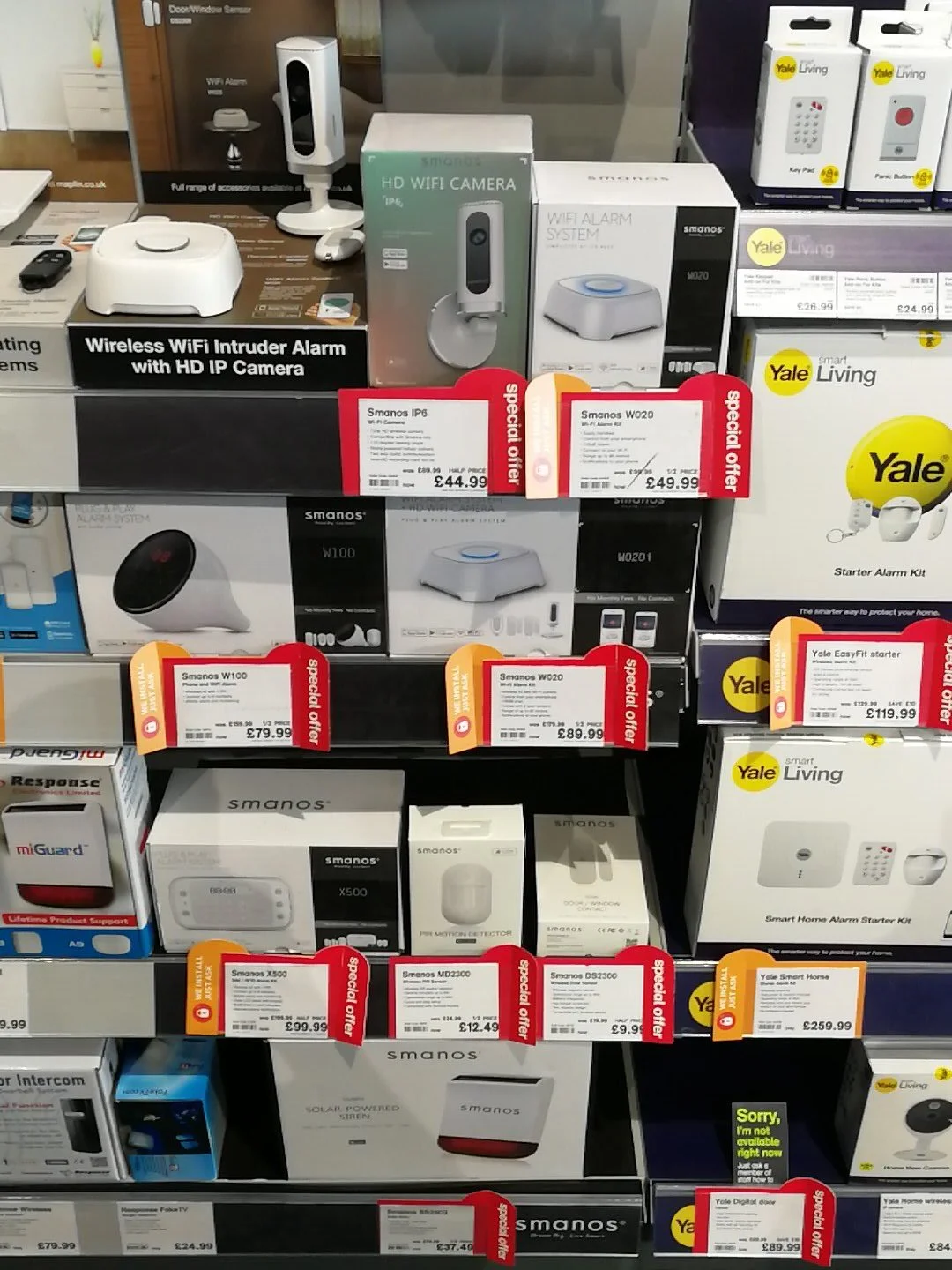
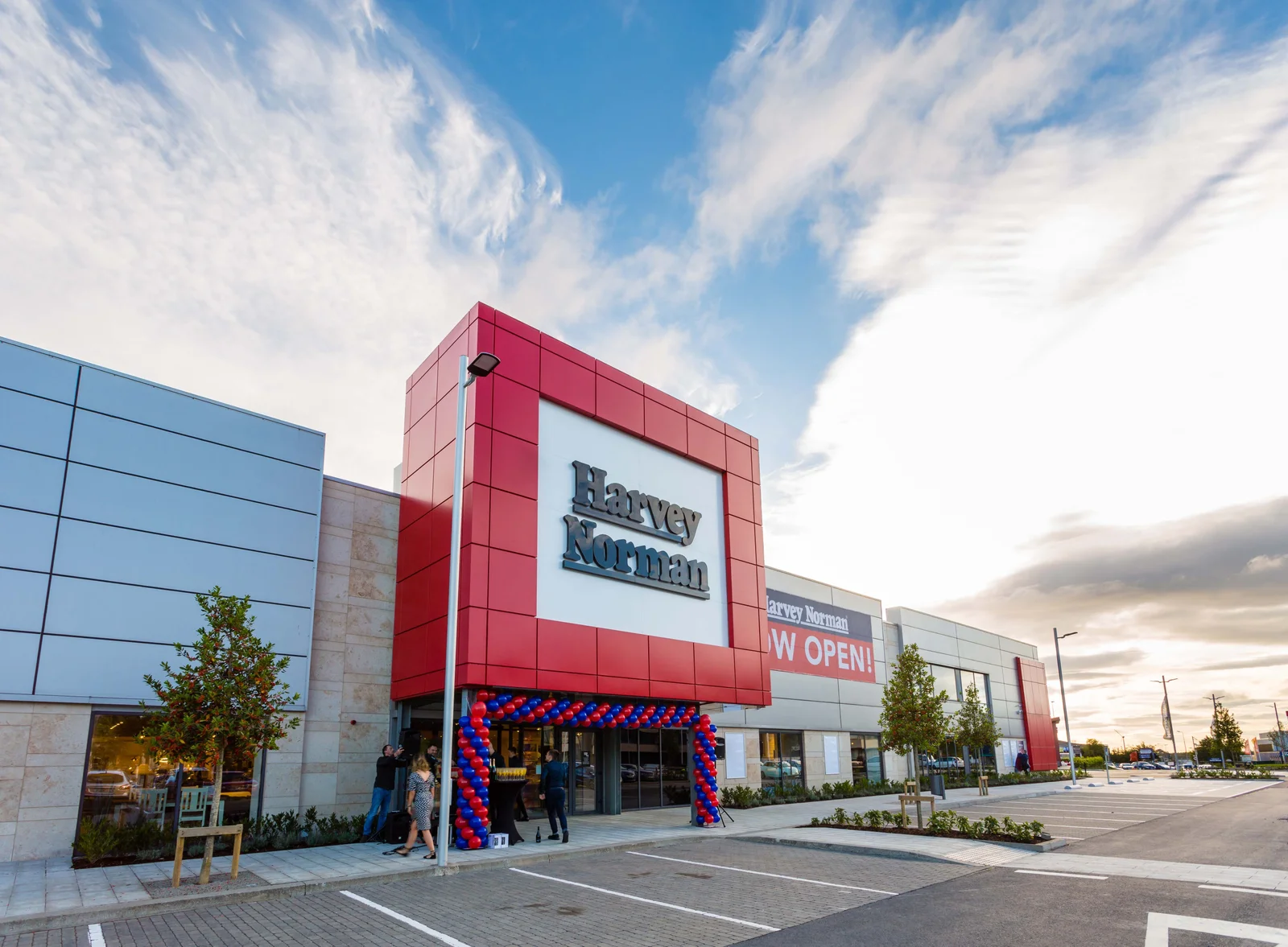
My employer-side work on the Harvey Norman connected-product rollout in Ireland involved more than obtaining a listing. Stock, store presentation and staff preparation also had to support the launch. I bring that practical experience into the launch plan.
If physical retail is part of the objective, use the UK electronics, DIY and online retailer guide to build the retail shortlist. Keep marketplace learning and retailer requirements connected from the start.
Turn the shortlist into an executable entry plan
Before committing stock, I want the team to agree where to launch, which products to offer, what each sale should earn and who will run the channel.
If your brand already sells successfully and is considering UK or European expansion, I can help assess the routes and coordinate the commercial work required to launch. That can include market selection, partner development and local commercial ownership, depending on the agreed scope.
Discuss your UK and European market-entry priorities or read what a market-entry assessment includes.
Frequently asked questions
Does marketplace popularity measure market share?
No. Surveyed shopper usage measures reported use of a platform. Sales market share measures spending within a defined market. A shopper can use several platforms, so usage percentages cannot be used to divide national sales between them.
Should a brand launch on Amazon across Europe first?
I would shortlist countries and product categories before choosing platforms. Amazon can be a candidate, but the decision also needs category demand, achievable contribution, local support and an operating owner. A familiar platform does not remove those decisions.
Can marketplace sales help a later retail launch?
They can supply evidence about demand, pricing and customer questions. A retail proposal still needs its own margin, stock, returns and demonstration plan. Online sales alone do not establish that a retailer will list the product.