For a Chinese smart-tech brand selling into the UK or EU, start with the factory price in US dollars, add freight and import costs, then convert into the currency of the destination market. Only then can you calculate what remains after retailer margin, distribution, fulfilment and marketing support.
Customs duty and import VAT are separate calculations. A 2.7% duty assumption is not a 2.7% import VAT rate. The worked example below shows how US$30 of product cost becomes US$37.50 of landed cost before recoverable import VAT, equivalent to £30.00 or €34.50 at explicitly illustrative exchange rates.
I use the assumptions below to open that discussion. They reflect my commercial experience and vary by product category, service requirement and negotiated agreement. They are not a survey of the UK market, a quotation, or published terms from any named retailer.
China to UK and EU landed-cost map
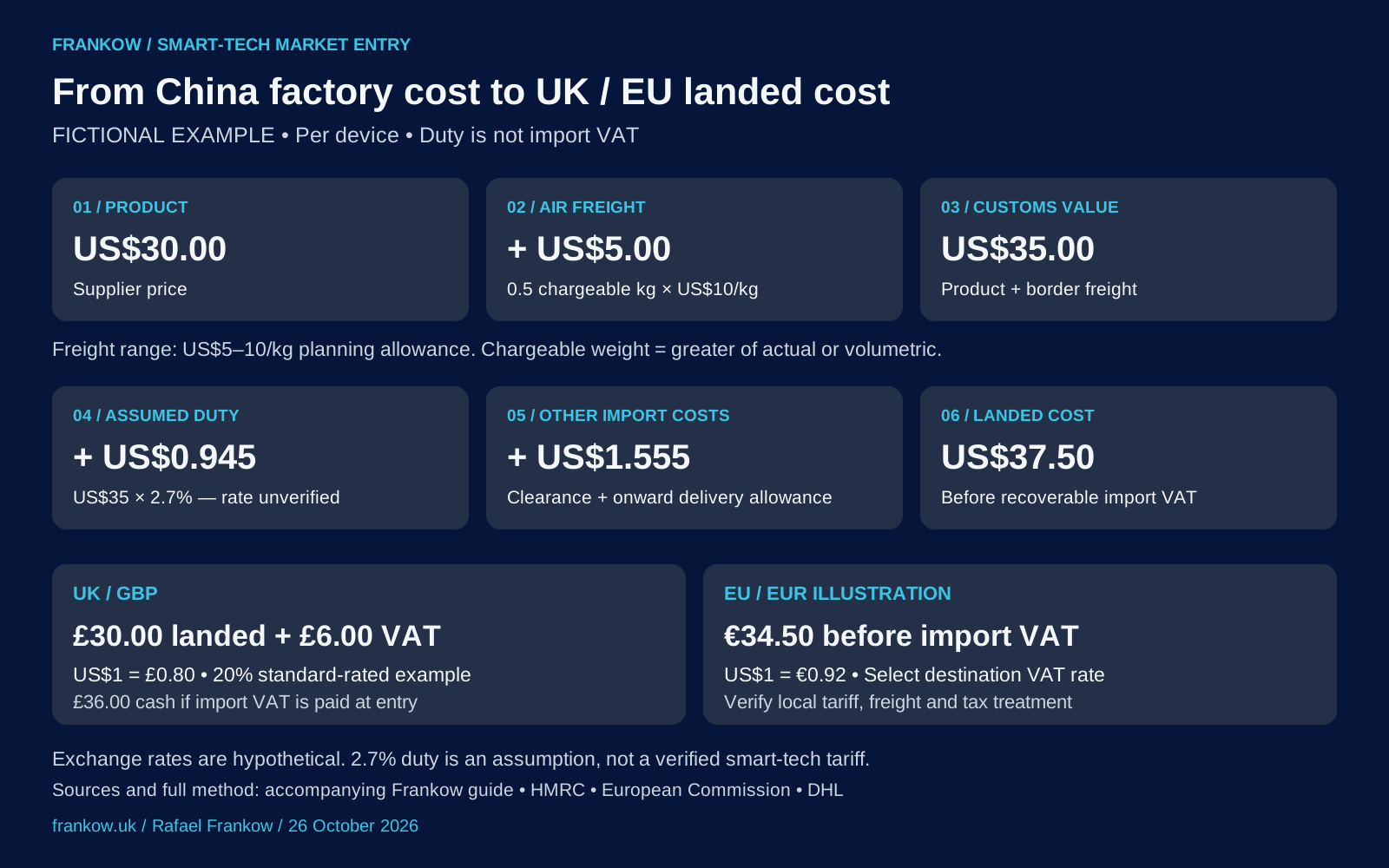
Open or download the full-size cost map. The method and every figure are also explained in text below. This is a fictional shipment, not a freight quote or tariff classification.
USD, pounds and euros: which currency should you use?
USD / US$ means US dollars, used here for the supplier and international freight quote. GBP / £ means pounds sterling for the UK model. EUR / € means euros for a euro-denominated EU model. Not every EU country uses the euro, and sharing a currency does not mean sharing a VAT rate or delivery cost.
Keep each channel comparison in one destination currency. In this article, the deliberately hypothetical planning rates are US$1 = £0.80 and US$1 = €0.92. They are not current exchange-rate quotes. Thus US$37.50 × 0.80 = £30.00, or US$37.50 × 0.92 = €34.50. To convert £30 back to dollars, divide by 0.80.
Use your bank or payment provider’s achievable rate and fees for commercial planning. Customs declarations may require an official customs exchange rate instead. Keep that rate separate from the commercial conversion. UK costs and margin observations below should not be treated as EU-wide terms.
How is air freight from China calculated?
For an initial smart-tech shipment plan, I allow US$5–10 per chargeable kilogram. This is my working range, not a verified live market average. Obtain a shipment-specific quote covering the lane, service, packaging and any product restrictions; battery-containing products need the forwarder’s specific acceptance and pricing.
Air freight commonly uses the higher of gross physical weight and volumetric weight. For a service using a 6,000 divisor:
Volumetric kg = length × width × height in centimetres ÷ 6,000, summed across cartons.
Chargeable kg = the higher of gross kg and volumetric kg, subject to the carrier’s rounding and minimums.
Freight per unit = chargeable kg × quoted US$/kg ÷ units shipped.
DHL’s chargeable-weight guide explains the method. Confirm the divisor for the booked service; do not assume every express or air service uses 6,000.
For example, 100 devices in ten cartons, each 50 × 40 × 15 cm and weighing 4 kg gross, occupy 50 volumetric kg but weigh 40 kg. At 50 chargeable kg, the US$5–10/kg allowance gives US$250–500 for the shipment: US$2.50–5.00 per device. The landed-cost example uses the upper US$5.00 per device. Add minimum charges, handling, insurance and other exclusions where quoted; do not count charges twice if included in an all-in price.
Customs duty comes before import VAT
For a straightforward percentage-duty illustration:
Customs duty = customs value × applicable duty rate.
The customs value can include product value, relevant transport and insurance to the import border, plus other required adjustments. It is not always just the supplier invoice. HMRC explains the delivery costs included in customs value.
The 2.7% below is an illustrative customs-duty rate only, not a verified rate for smart-home products, cameras, controllers or any named category. Confirm the commodity code, origin, destination, date and applicable measures using the UK Trade Tariff or EU TARIC. Do not carry a UK classification/rate into an EU model without checking it.
Import VAT = applicable VAT rate × (customs value + duty + other amounts required in the VAT base).
Relevant onward transport and incidental expenses may also belong in that base. Both HMRC’s valuation guidance and the European Commission’s import VAT explanation distinguish this broader VAT base from customs value. The calculation (product + shipping) × 2.7% gives only the duty in this simplified example; it does not give VAT or the total landed cost.
Worked landed cost: USD, GBP and EUR
This simplified example assumes no separate insurance or other customs-value adjustment, and treats the clearance/onward-delivery allowance as additional to customs value and included in the VAT base. Actual treatment must follow the shipment. The same assumed duty is used in both currency columns purely to illustrate conversion, not to assert matching UK/EU tariffs.
| Per device | USD supplier-cost model | GBP illustration | EUR illustration |
|---|---|---|---|
| Product | US$30.00 | £24.00 | €27.60 |
| Air freight to import border | US$5.00 | £4.00 | €4.60 |
| Customs value in this example | US$35.00 | £28.00 | €32.20 |
| Assumed duty: 2.7% of customs value | US$0.945 | £0.756 | €0.8694 |
| Clearance and onward delivery allowance | US$1.555 | £1.244 | €1.4306 |
| Landed cost before recoverable import VAT | US$37.50 | £30.00 | €34.50 |
Extra decimals make the arithmetic traceable; customs/accounting rounding may differ. The customs-value row is a subtotal, not an additional cost. The clearance allowance is selected for this fictional example, not a market rate.
For a UK standard-rated example, import VAT at 20% on the £30 assumed VAT base is £6. If paid at import, this creates a £36 per-unit cash requirement before later recovery, where eligible. If VAT cannot be recovered it belongs in economic cost; eligible postponed accounting changes payment timing. The UK standard VAT rate is 20%. Select the actual product and destination rate for an EU shipment; there is no single EU VAT percentage.
This £30 / US$37.50 landed cost is the input used in the UK channel comparison below. The EUR column is a currency illustration; a real EU launch needs local freight, tariff, VAT and channel assumptions.
What margins should a smart-tech brand allow for?
| Cost or channel | Starting point for a planning scenario | What to check |
|---|---|---|
| Retailer dropship | Retailer margin up to 25% | Who is the seller, who fulfils the order, and which returns or service charges apply? |
| UK parcel delivery | £4–£6.50 per parcel as a working range; larger items can cost more | Size, weight, destination, VAT basis, tracking, signature, insurance and surcharges. |
| Stockholding retailer | Allow 30–35%, with higher requirements possible | Category, range, promotional obligations and additional commercial terms. |
| Value-added distributor | Allow a 20% distributor gross margin | What sales development, account support, stockholding and other services are included? |
| Simpler supply arrangement | Allow a 6–9% margin where the partner buys and resells | A service-only 3PL usually needs its quoted fee structure modelled instead of a resale margin. |
| Marketing development funds (MDF) | Include an editable buffer; the example below uses 10% | Percentage of which revenue, who pays, when it becomes payable, and whether other charges already include it. |
These figures are dated planning observations supplied on 26 October 2026. An actual agreement takes precedence. A lower percentage does not necessarily mean a lower total cost or a better route to market.
Map the commercial route before calculating it
| Route | Who buys from the brand? | Who delivers to the consumer? |
|---|---|---|
| Direct retail: brand → retailer → shopper | Retailer | Retailer or its delivery provider |
| Distribution: brand → distributor → retailer → shopper | Distributor | Retailer or its delivery provider |
| Retailer dropship: brand → retailer sale → shopper | Retailer, under the agreed commercial model | Brand or its fulfilment provider |
| Amazon seller with FBA: brand → shopper | Shopper through the marketplace | Amazon fulfilment network |
| Amazon merchant fulfilled: brand → shopper | Shopper through the marketplace | Brand or its fulfilment provider |
A 3PL can support several of these routes without buying the stock. Its operational role does not automatically make it a distributor. Similarly, selling to Amazon as a wholesale vendor is a different arrangement from selling through an Amazon seller account.
For retailer selection and sourced scale figures, use the UK electronics, DIY and online retailer map. Retailer size helps frame the opportunity; it does not reveal the terms that retailer will offer your brand.
Retailer margin and distributor margin are successive calculations
Gross margin is measured against selling price. A 30% margin on a £100 sale leaves £70 to buy the product. It is not the same as adding 30% to a cost.
For a route with a retailer and a distributor:
Retailer buy price = consumer price excluding VAT × (1 − retailer margin).
Brand invoice price = retailer buy price × (1 − distributor margin).
In a fictional example with a £100 consumer price excluding VAT, a 30% retailer margin leaves £70. A 20% distributor margin on that £70 leaves £56 as the brand’s invoice price. Adding the two margins together and deducting 50% from £100 would give the wrong result.
Use the actual negotiated brand invoice price when it is known. Do not deduct the same channel margins again from a price that already reflects them.
How should MDF be built into the price?
Marketing development funds can support agreed activity such as demonstrations, product content, training or campaigns. The model should identify the amount and its basis before treating it as a cost.
For the worked example, I have allowed 10% of the brand’s invoice revenue before MDF. This is a planning buffer, not a claim that every industry or account requires 10%. On a £56 brand invoice, that buffer is £5.60. Calculating it against the £100 consumer price would instead reserve £10: a materially different assumption.
Keep three things distinct: a buffer reserved in the plan, a contractual allowance payable to a partner, and actual marketing expenditure. If they describe the same funding, count it once. If the agreement requires separate funding, show the separate cost explicitly.
Worked comparison: what remains from the same product?
The following scenarios use a fictional £100 consumer price excluding VAT, £30 landed unit cost (US$37.50 / €34.50 at the illustrative rates above) and a 10% MDF reserve on brand invoice revenue. They demonstrate the arithmetic, not actual retailer terms or forecast sales.
| Per-unit calculation | Direct retailer | Value-added distributor route | Retailer dropship |
|---|---|---|---|
| Consumer price excluding VAT | £100.00 | £100.00 | £100.00 |
| Retailer margin assumption | 30% | 30% | 25% |
| Distributor margin assumption | None | 20% | None |
| Brand invoice revenue | £70.00 | £56.00 | £75.00 |
| MDF reserve | £7.00 | £5.60 | £7.50 |
| Landed unit cost | £30.00 / US$37.50 | £30.00 / US$37.50 | £30.00 / US$37.50 |
| Consumer parcel delivery allowance | Not included | Not included | £4.00–£6.50 |
| Remaining before other costs | £33.00 | £20.40 | £31.00–£33.50 |
The remaining amount is not net profit. Direct retail and distribution still need their applicable bulk-delivery and account costs. Dropship still needs any pick-pack, packaging, support, returns or other charges not included in the parcel quote. All routes need the relevant trading terms, overhead and launch costs. The parcel amounts in this illustration are assumed to be comparable net costs; check the VAT basis of the actual quote.
Compare the sensitivity as well. Moving the direct retailer margin from 30% to 35% reduces the brand invoice to £65. After £6.50 MDF and £30 landed cost, £28.50 remains before other costs. That is £4.50 less per unit than the 30% scenario.
Annual rebates and payment discounts need their own lines
A headline margin does not describe the full agreement. Annual rebates, early-payment discounts, promotions, returns allowances and other deductions can change the outcome.
Record each deduction with its percentage or amount, calculation base, qualifying conditions and payment date. Do not assume all percentages apply to the same base. If a rebate is conditional on annual volume, show both the qualifying and non-qualifying scenarios rather than silently assuming the threshold will be reached.
A payment discount also changes timing. The model should show the lower receipt and its earlier date together, so that a better cash position is not confused with a higher margin.
Dropship delivery needs more than the cheapest parcel rate
In smart tech, I use £4–£6.50 per UK parcel as an initial delivery allowance, with more for larger or heavier products. Cheaper services may be available, but many retailer arrangements require tracked and signed delivery. Confirm the actual account requirement before choosing a rate.
Ask whether the quote includes packaging, picking, fuel or remote-area surcharges, and the required delivery service. Check multi-item orders too: a per-parcel charge is not automatically a per-unit charge. Returns, failed deliveries and replacement shipments need separate assumptions where they are not already included.
A 6–9% supply margin is not interchangeable with a 3PL fee
A simpler supply partner may work on a 6–9% margin when buying and reselling. That is a different commercial proposition from a value-added distributor carrying a broader sales and support role.
If the provider only stores and ships your stock, enter its actual storage, handling, pick-pack, transport and account charges. If it quotes a percentage service fee, name the fee base. Do not apply both a resale margin and service charges for the same work unless the agreement explicitly requires both.
Where Amazon FBA fits into the comparison
For an EU marketplace, use that country’s fee schedule and VAT treatment; the UK schedule is not an EU-wide rate card.
For Amazon seller scenarios, begin with the consumer selling price and deduct the applicable output VAT, Amazon charges and brand costs. Use Amazon’s current UK pricing and revenue calculator for the product-specific fee estimate, then add costs missing from that estimate.
Include inbound preparation and transport, storage, advertising, expected returns losses and account costs where applicable. Keep an explicit record of what the imported estimate already includes. For merchant fulfilment, replace FBA fulfilment with the actual warehouse and delivery costs; do not charge both for the same shipment.
Compare the routes at realistic volumes and service levels. A higher contribution per sale does not establish that a route will generate more sales or require less working capital.
Imports and working capital can change the decision
Build landed cost from the supplier price, currency conversion and the freight, duty, clearance and inbound charges the brand actually bears. If a delivered quote already includes a component, do not add it again.
Separate recoverable VAT from permanent costs and from cash paid before recovery. Treatment depends on the transaction and business; check HMRC’s import VAT guidance and the advice relevant to your arrangement.
Finally, put the payments on a timeline: supplier deposits, stock payment, launch spend, delivery charges and customer receipts. A route can produce a positive contribution while requiring significant cash before the first payment arrives.
Turn the calculation into a launch decision
The useful output is a clear view of the assumptions to negotiate: price, margin, MDF, service responsibilities, returns exposure and payment timing. Keep an optimistic, working and pressured scenario rather than treating one number as a forecast.
If you have a proven smart-tech product and are choosing a UK or EU route, I can help turn those assumptions into a practical market-entry assessment, connecting the economics with retailer fit and the work required to launch.