Getting a consumer-tech product into UK retail takes more than a buyer introduction. The buyer needs to see who will buy it, where it fits in the range, what the retailer earns and who handles delivery, setup and returns.
For an established brand from China, Taiwan, South Korea, Japan or another overseas market, existing sales are a useful starting point. Show which customers buy, through which channels and why they return the product. Then explain what you will put behind the UK launch.
My advice is to start with a manageable range and accounts that suit the product. A smart lock, a home-security camera and a portable power station may all be consumer technology, but the buying decision, demonstration and after-sales questions are different.
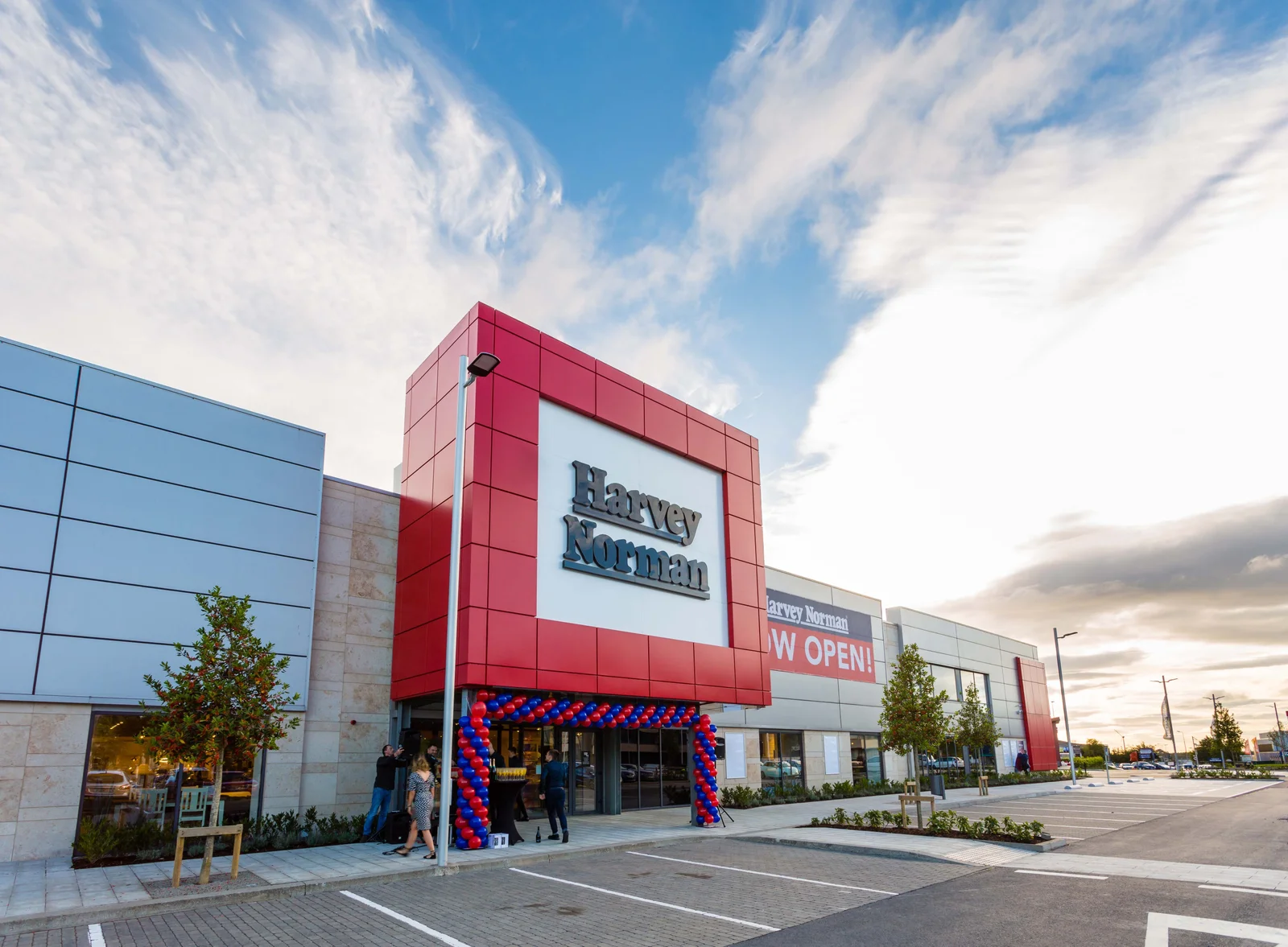
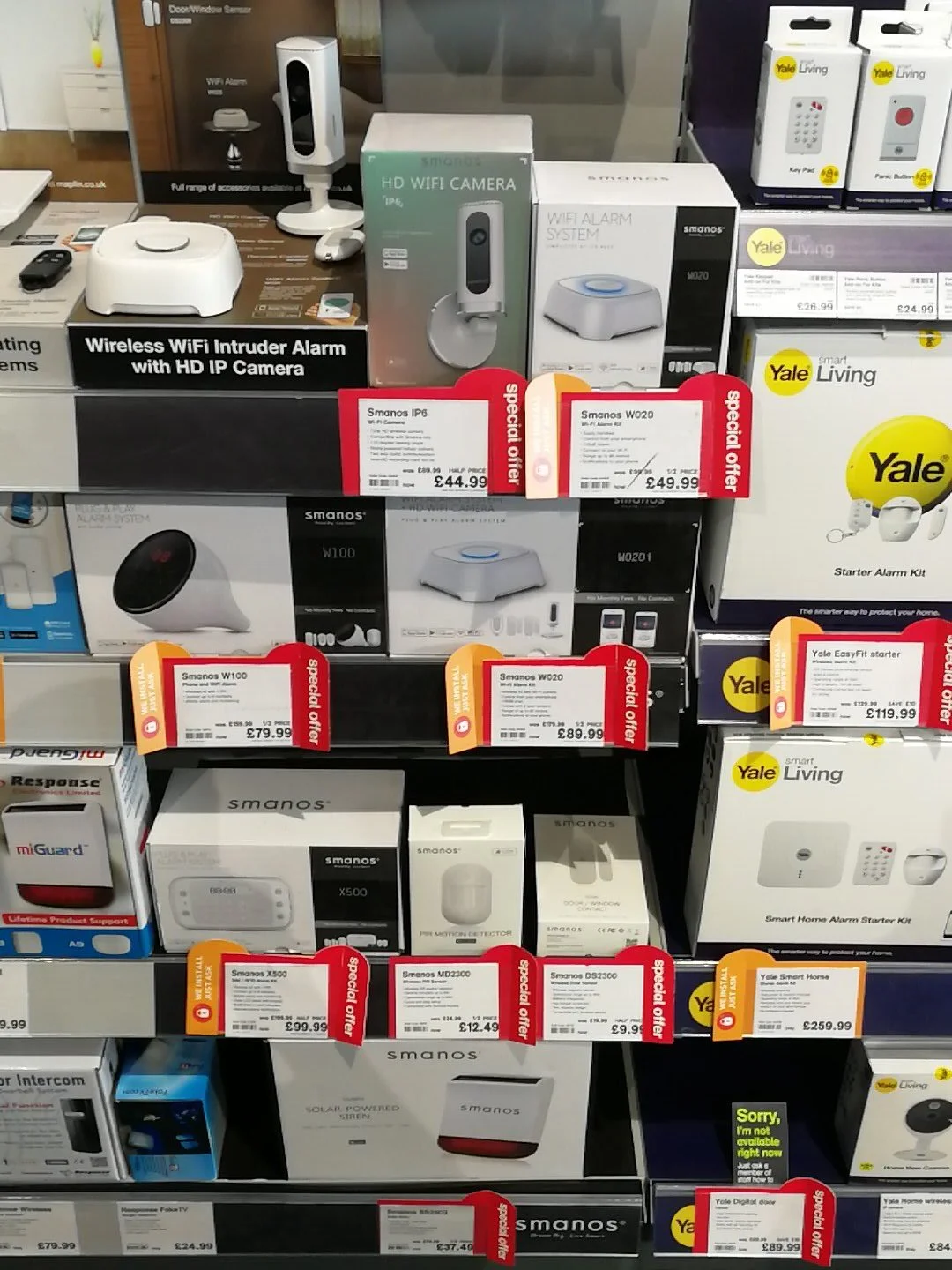
In my employer-side work, I coordinated a connected-product rollout across 16 Harvey Norman stores in Ireland, working with the distributor, retailer and display manufacturer, and coordinating launch training. That experience informs the practical steps below. The case study shows how the display, stock and people came together.
Is this account right for your product?
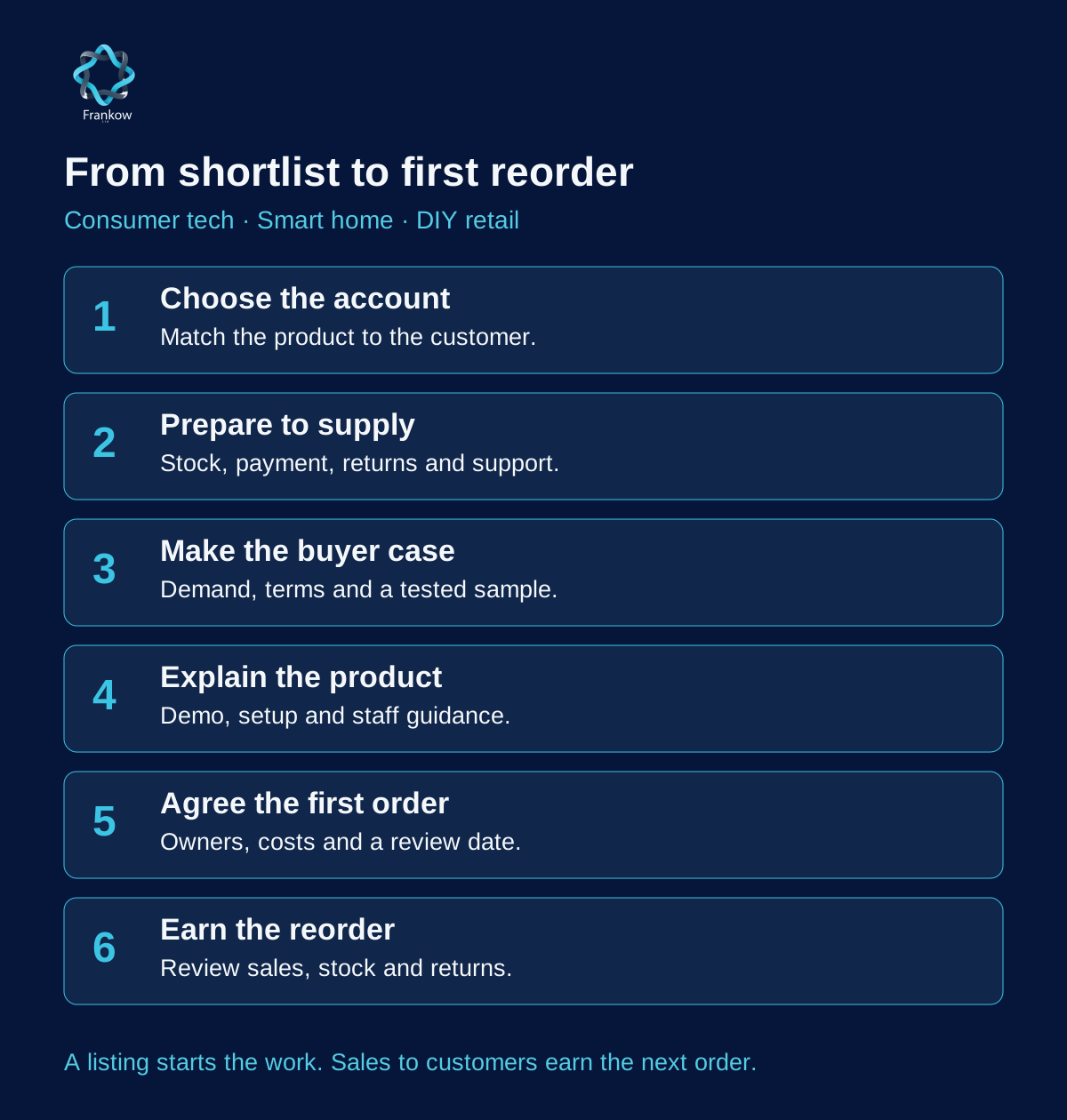
Choose the account around the customer’s task. For smart-home products, consider both electronics and home-improvement channels. These examples show how to assess fit; they are not Frankow Ltd clients or a list of buyers currently accepting suppliers.
| Channel example | What to investigate before approaching the buyer |
|---|---|
| Currys: smart-home range | Where does your device fit alongside products customers already understand? What must staff explain about setup, compatibility and subscriptions? |
| Screwfix: connected-home categories | Does the product solve an installation, security, heating or lighting task? Are compatibility information, installation instructions and replacement-stock arrangements clear? |
| B&Q Marketplace | Can you operate as a third-party seller, fulfil orders and support customers? Its marketplace route is a separate proposition from securing a stocked store range. |
For a broader account shortlist, use my UK electronics and DIY retailer guide. Here the focus is what to do after choosing an account: reach the right buyer, get the product evaluated and agree a workable first order.
Ask whether the opportunity is stocked retail, retailer dropship or a marketplace listing. An online product page does not establish an in-store commitment, demonstration space or staff training.
Can the retailer actually buy from you?
Settle the supply arrangements before offering a launch date:
- Who supplies and invoices? Identify the selling entity, invoice currency, stock location and delivery responsibility. Confirm who handles importing where required.
- Who funds the order? Compare your factory-payment dates with the proposed retailer-payment dates. Include freight, launch spending and the cash tied up in unsold stock.
- Who resolves problems? Give the buyer a named contact for shortages, faulty products, warranty cases and replenishment.
- Is the product ready? Check the applicable product rules and the buyer’s onboarding requirements. Packaging, English instructions, barcodes, insurance and electrical compatibility need attention, but not every retailer request is a legal requirement.
For products covered by the UK connected-product security regime, check the security obligations and accompanying statement of compliance. Manufacturers, importers and distributors have responsibilities; check the scope and exemptions for the particular device.
A distributor can help when its stockholding, credit, logistics and account support justify its margin. Agree which responsibilities it will take on. An introduction alone does not solve the supply problem.
What should you send a UK retail buyer?
Send a short, account-specific introduction and a clear product sheet. Make it easy for the buyer to judge the customer, the commercial opportunity and the proposed next step.
Prepare these six things before making the approach:
- A reason this retailer should care. Name the customer need and explain where the product fits in its current range. Avoid a general “we want a UK partner” opening.
- Evidence of demand. Separate sales to distributors from sales to end customers. Give the period, market and channel behind the numbers. Include relevant reviews and return reasons where you can substantiate them.
- A usable product sheet. Key benefit, photographs, dimensions, packaging, barcode, model variants, compatibility and any software or subscription requirements.
- A commercial proposal. Suggested retail price with VAT clearly identified, trade price, currency, delivery basis, opening quantity and payment proposal. Show distributor margin separately if one is involved.
- A support plan. Stock location, replenishment lead time, customer support, warranty handling, faulty-product process and someone authorised to resolve problems.
- A specific request. A category discussion, product evaluation or demonstration, with the right sample available.
Find the person responsible for the category or range, and check the retailer’s supplier process. Customer-service teams and store staff can help you understand the business, but they may not have purchasing authority.
Ask when the category is reviewed and what the buyer needs before that date. Before sending a sample, agree who will evaluate it, what they need to test and when you will discuss the result. Otherwise you can lose several weeks without learning whether the obstacle is product fit, timing, terms or simply an untested box.
Make the demonstration useful enough for staff to repeat
A retail demonstration should show one valuable customer task, work reliably in the store and be simple enough for a trained member of staff to repeat.
For a smart lock, demonstrate a real task such as creating and withdrawing a temporary access code. Explain which doors it fits, how it is installed, what happens when the battery runs low and whether an account, hub or subscription is needed. Use the actual product’s capabilities, not a polished video that skips the difficult setup steps.
The format matters. A staffed electronics display may support a live demonstration. A DIY shelf, trade counter or online listing may need packaging, an installation guide and a short product video to do more of the explaining. Do not budget on the assumption that every store has someone available to demonstrate your device.
The demo plan needs an owner and a budget:
- Agree who supplies and owns the lock, mounted door or display fixture, phone or tablet, demo account and spare batteries. Include a hub if the product needs one.
- Confirm power, any required Wi-Fi access and permission to use the app before the visit. Use a dedicated demo account and agree who resets access codes after demonstrations.
- Give staff a short demonstration guide, common questions and a clear support contact.
- Arrange training around staff availability, including a way to train people who miss the first session.
- Agree who checks that the display still works and replaces damaged or missing parts.
- Record customer questions, trial activity where measurable, sales and returns. A busy demonstration with no purchases still needs investigation.
Price the launch, including MDF and delivery
Work back from the customer’s price and leave room for every party to do its job. Retail margin is only one part of the brand’s calculation.
MDF means market development funds: a budget agreed with a partner for activities such as content, email promotion, events or demonstrations. Specify the activity, amount, approval process and evidence of delivery. If MDF is a percentage, name the base: a percentage of wholesale purchases is different from a percentage of retail sales.
Here is a simple illustrative stocked-retail calculation, not a quoted retailer requirement. A £120 customer price including 20% VAT is £100 before VAT. A 30% retailer gross margin on that £100 leaves a £70 wholesale price. From the brand’s £70, deduct £35 landed product cost, £7 MDF reserved at 10% of the brand’s invoice revenue, £2 delivery allocation and a £1.50 returns provision. That leaves £24.50 per unit before fixed launch costs and overheads. The 10% is a planning reserve consistent with my margin guide, not a standard retailer charge. Demo equipment, training and the cost of waiting for payment still need funding. A distributor would require its own economics within the price structure.
For dropship orders, calculate the parcel cost separately from any delivery payment received. A £6.50 tracked-delivery planning allowance costs the brand £6.50 if it receives no reimbursement; £4 passed on to the brand net of VAT leaves a £2.50 subsidy. These are example amounts—confirm the packed product’s actual delivery and returns costs before quoting.
Ask about promotional contributions, settlement deductions, markdown support, price protection if you reduce your own supply price, and returns rights before accepting the opening order. My landed-cost and channel-margin guide explains the wider calculation.
A recommended retail price is a recommendation. The retailer must remain free to set its resale price; the CMA’s guidance on resale-price maintenance explains the competition-law issue.
What should the first retail order include?
The first order should be large enough to support the agreed launch, with clear responsibilities and a review date. There is no useful universal opening quantity: it depends on the range, number of locations, demand evidence and replenishment time.
Before stock moves, settle the following in writing:
| Item | What to agree |
|---|---|
| Products and quantities | Exact models, variants, barcodes, saleable units and separate demo units |
| Delivery | Destination, date, freight payer, booking requirements and responsibility for import arrangements |
| Payment | Currency, payment trigger, due date, credit arrangements and permitted deductions |
| Returns | Faulty goods, unwanted stock, damaged deliveries, authorisation and freight responsibility |
| Launch support | Product-page content, staff training, demo setup, promotional activity and named owners |
| Review | Sales and stock information available, meeting date and the evidence needed to continue |
For a two-store pilot, allocate saleable stock and demo units separately, agree who checks the displays, and schedule the review before launch. The quantity should follow a cash and replenishment plan, not a desire to announce a large first order.
A retailer’s purchase order is sell-in. Sales to end customers are sell-through. Review both, alongside stock availability, returns and cash due. If a product is not moving, establish whether shoppers saw it, staff could explain it, the proposition made sense and the stock was actually available before pushing for a larger order.
If exclusivity is requested, define the products, territory, channels, duration and performance obligations. Get appropriate contractual advice before committing. One promising meeting is too little evidence for an open-ended European exclusive.
Plan the UK launch with Europe in mind
A UK pilot can give an overseas brand evidence about customer questions, product presentation and partner support. It does not automatically establish demand or readiness in Germany, the Nordics or another European market.
Before expanding, revisit the local retail range, price, language, stock and after-sales arrangements. Check product obligations for each destination. Great Britain’s product-conformity guidance and the EU’s importer and product-compliance guidance describe different responsibilities; Northern Ireland also needs its applicable rules checked. A UK launch is not an EU compliance clearance.
My earlier Smanos/Chuango brand-side work covered UK and DACH distribution, retailer conversations and promotions. Expansion needs that local account work again; a successful UK pilot is useful evidence, not a ready-made European rollout.
Where I can help
I work with established international brands that have a differentiated product, evidence of sales and the budget and support capacity to develop UK and European channels. That includes brands with a UK representative who needs additional retailer access and commercial follow-through.
Through Frankow Ltd, I can help assess the route, prioritise suitable partners, prepare the commercial case and support agreed conversations through negotiation and launch planning. The retailer decides whether to buy; my job is to make the opportunity credible and keep the work moving.
If the route is still uncertain, a scoped Market Entry Assessment can help establish the priorities. If you already know the market and need partner development, see how I work on distribution and retail relationships.
To start a discussion, bring the product, current markets, indicative customer price, stock position and the specific channel problem you need to solve. Discuss your UK and European retail plans.