
UK retailer and distributor
margin calculator
Would your consumer-tech product make money through UK retail? Enter your price and costs, then check what is left after the retailer, distributor and marketing support.
Retailer and distributor margins: questions before you agree terms
These are my starting points from commercial experience, reviewed 9 November 2026—not a market survey or a retailer’s quotation.
What retailer margin should I allow for a consumer-tech product?
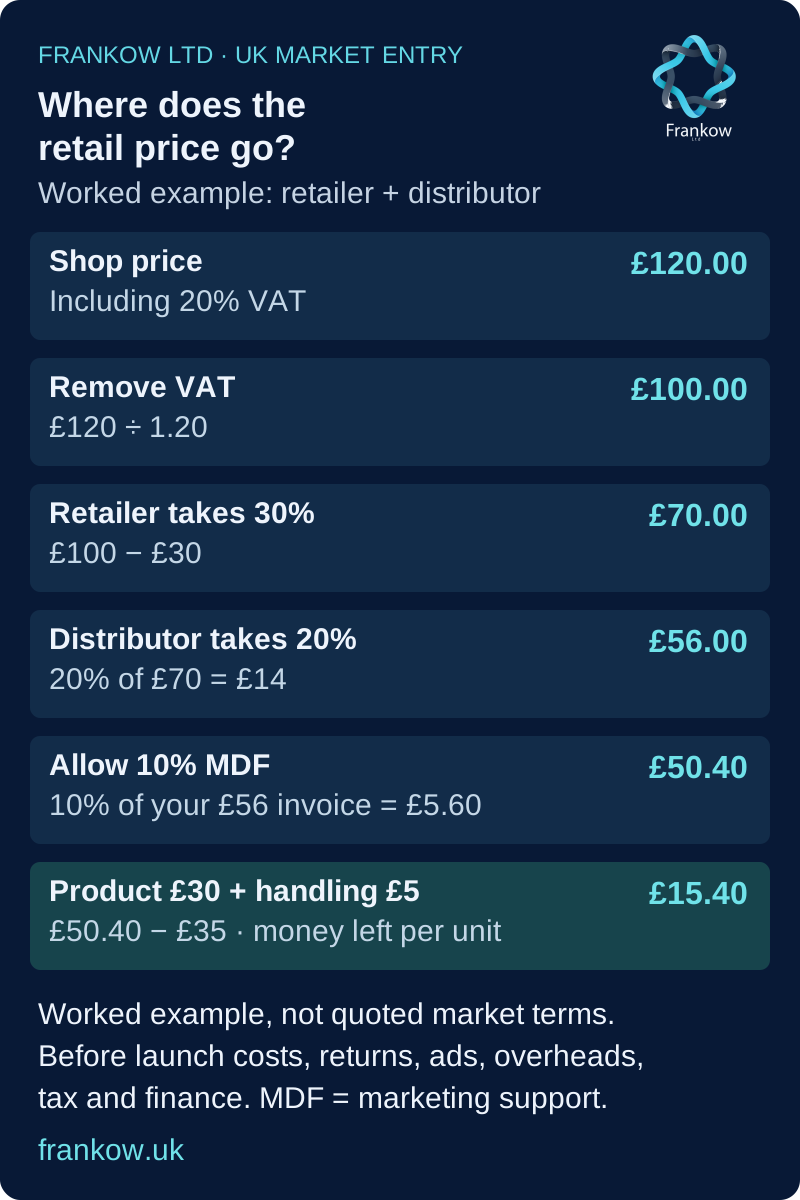
I use 30–35% for stocked retail, depending on category and account. A 30% margin on a £100 selling price excluding VAT means buying at £70. Margin is not markup: adding 30% to £70 gives £91, a margin of about 23.1%. Check MDF, rebates, delivery and returns separately.
What margin should I allow for consumer-tech dropship retail?
I test 15–25% of the shop price excluding VAT; some smaller arrangements can work at around 10%. At £120 including 20% VAT, a 20% dropship margin leaves £80 before MDF and your costs. Allow for the delivery, handling, support and returns you cover. This is the retailer’s share, not your profit.
What should a value-added distributor’s margin pay for?
I use 20% to plan value-added distribution. Agree whether it covers sales development, account management, stockholding, retailer support and launch activity. Price any additional work separately and agree which marketing activity MDF funds. Apply margins in sequence: £100 net becomes £70 after 30% retail margin, then £56 after 20% distributor margin.
When can a 5–9% distribution margin work?
I use 5–9% for simpler supply arrangements with 3PL support where the partner buys and resells. Enter it as the distributor margin. For a service-only 3PL, add pick-and-pack fees and an allocated storage cost per sale to “Handling and support per sale”. Put customer delivery in the delivery field where shown. Avoid counting logistics costs already included in a partner’s margin twice.
What MDF should I allow, and on which price?
The example uses 10% for marketing support; agree the activities, evidence and spending cap. The base matters: 10% of your £56 distributor invoice is £5.60, leaving £15.40 after £35 product and handling costs. On the retailer’s £70 buy price, MDF is £7 and £14 remains. Select the agreed basis in the calculator.
Read my guide to landed costs, MDF and channel margins for the fuller examples, or see approaching UK electronics and DIY retailers.
By Rafael Frankow · Published 9 November 2026. This is a UK calculator in pounds; rebuild the inputs for each EU country and currency. Your figures stay in this browser.