The short-term rental sector is not one software category. It is a connected operating environment in which property managers, booking channels, property management systems (PMS), revenue tools, payments, operations, access control and guest technology all depend on one another.
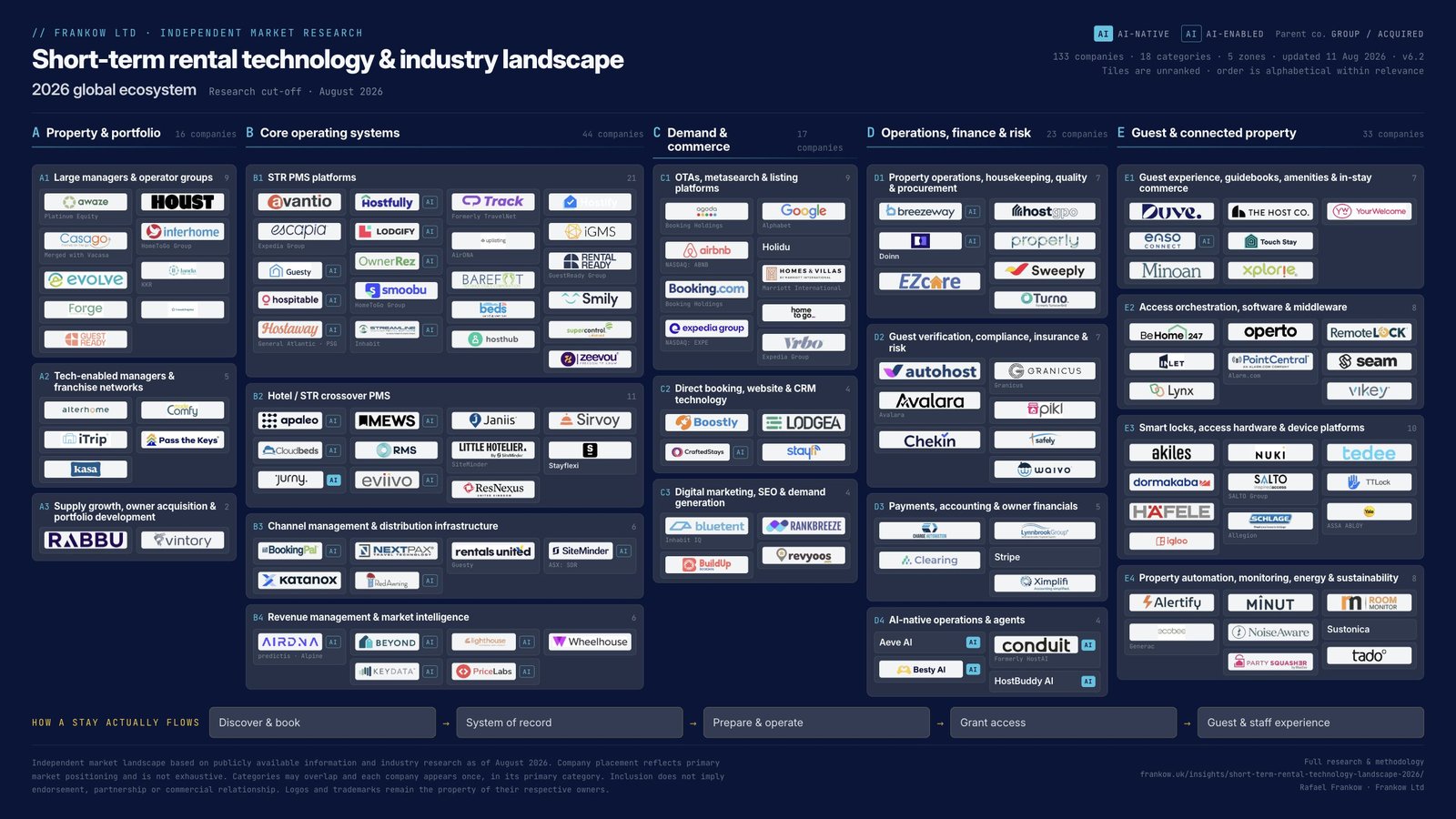
I built this landscape for technology brands, connected-product companies, software platforms and operators trying to understand where they fit—and where a partnership or integration could create a practical route to growth. It maps 133 companies across 18 categories and five commercial zones, including 32 property management systems, then connects those zones to the way a stay actually flows: discovery and booking, system of record, preparation and operations, access, and the guest and staff experience.
The map is a practical market-development tool rather than a directory of logos. It helps me identify where a company sits, which adjacent partners could strengthen its offer, where integrations can create a route to market and where a category may already be crowded.
What the market structure tells a technology brand
The category counts reveal a fragmented ecosystem. There are 32 PMS platforms in the map, alongside six distribution-infrastructure businesses, six revenue and market-intelligence platforms, eight access-orchestration companies and ten smart-lock or access-hardware businesses.
For a company entering the short-term rental market, that creates both opportunity and noise. Compatibility with a long list of systems is not automatically a go-to-market strategy. The commercial question is which customer group has the strongest problem, which systems already influence that group and which small number of integrations or partnerships can unlock repeatable demand.
A connected-product brand may first need a hardware channel and installation model. An integration platform may grow through PMS relationships, compatible device partners and enterprise deployments. A guest-experience product may need access to operators and property managers rather than another marketplace listing. The right route depends on where the product creates value in the operating workflow.
What the five zones show
The landscape is organised around the commercial and operational role each company primarily plays.
- Property and portfolio covers large managers, technology-enabled operators, franchise networks and businesses focused on acquiring or developing supply.
- Core operating systems includes short-term rental and crossover property management systems, distribution infrastructure and revenue-management technology.
- Demand and commerce covers online travel agencies, direct-booking technology and demand-generation tools.
- Operations, finance and risk includes housekeeping, procurement, verification, compliance, insurance, payments and AI-led operational tools.
- Guest and connected property covers guest experience, access orchestration, smart locks and property monitoring or automation.
Each company appears once, in the category that best reflects its main market position. Many products naturally overlap several areas. The aim is to make the ecosystem readable, not to imply that every company has only one capability.
Why middleware and smart-lock hardware are separated
One of the most important distinctions is between access orchestration software and access hardware.
Platforms such as Inlet, RemoteLock and Seam connect software systems with compatible lock or access products. They do not belong in the same primary category as manufacturers whose proposition centres on the physical lock or device.
That separation matters commercially. A hardware manufacturer may need distribution, retail, installation and product support. Middleware may grow through property-management integrations, hardware partnerships, enterprise projects and recurring software revenue. Putting both into a single smart-lock category hides the different routes to market.
How I use the landscape for market development
I do not use a market map as a list for mass outreach. I use it to ask better commercial questions.
- Which category has the clearest customer problem?
- Where is the company genuinely differentiated?
- Which integration would remove friction or unlock an established customer base?
- Is the opportunity driven by hardware revenue, software attachment, recurring usage or a combination?
- Which potential partners are complementary rather than direct competitors?
- Where can one successful deployment be repeated?
This turns a broad ecosystem into a smaller set of commercially relevant routes. The next step is then deeper research: product compatibility, pricing, existing integrations, target customers, sales cycles and the operational work required after an introduction.
How I built and review the map
I started with established industry landscape material, then checked the market again using current, publicly available company and product information. Companies were retained, removed, added or repositioned according to their strongest visible role in 2026.
Each company appears once. That rule keeps the map readable, but it also forces a useful commercial judgement: what is the main reason a customer or partner would engage with this business? Where a company spans multiple categories, I classify it by the proposition most relevant to its market position rather than trying to repeat it across the page.
I also separate active evidence from assumption. AI markers reflect visible product positioning, not a general claim that a company uses no AI elsewhere. Company inclusion is not a ranking or endorsement. The landscape is a dated research snapshot designed to support better questions and more focused follow-up work.
What the AI markers mean
The map distinguishes between AI-native companies and AI-enabled companies.
AI-native means the product is fundamentally built around an AI-led operating model or agent. AI-enabled means AI is a meaningful part of the proposition but not the entire product category. Companies without a marker may still use machine learning or automation internally; the map only marks externally visible positioning that is relevant to the category.
The markers are descriptive, not a quality ranking. The same applies to every tile: inclusion does not imply endorsement, partnership or commercial relationship.
What this landscape does not claim
This is an independent research snapshot, not an exhaustive directory. The sector changes quickly through acquisitions, new products, changing positioning and integrations.
Company placement reflects the strongest publicly visible use case as of August 2026. Categories can overlap, and a company may serve several customer types or parts of the guest journey. Logos and trademarks remain the property of their respective owners.
I plan to update the landscape as the ecosystem develops. If you believe a company is missing or should sit in a different category, send me the evidence and your suggested change.
What this says about the STR opportunity
The strongest opportunities often sit between categories rather than inside one isolated product.
A lock becomes more valuable when access is automated from a booking or property-management workflow. A guest application becomes more useful when it connects communication, access and in-stay services. A hardware sale can create recurring value when integrations, monitoring or operational software remain attached after installation.
That is why I look at partnerships and integrations as commercial infrastructure, not only technical features. The map helps reveal where those connections can create a more defensible offer and a clearer route to growth.
For a brand considering the STR or hospitality market, the useful next step is not mass outreach to all 133 companies. It is to define the most credible place in the workflow, select a focused customer or partner group, test the commercial assumptions and build the evidence needed for a repeatable route to market. That is the same research-led approach I use in my UK and European market-entry work and when developing software integrations and recurring-revenue partnerships.
Frequently asked questions
What is included in the short-term rental technology landscape?
The landscape maps 133 companies across 18 categories, from property managers and PMS platforms to distribution, revenue management, operations, payments, guest experience, access software, smart locks and property automation.
How many property management systems are included?
The 2026 landscape includes 32 property management systems: 21 STR-focused PMS platforms and 11 hotel or STR crossover systems. They are separated from channel managers, middleware and access hardware.
Why are access middleware and smart locks shown separately?
Access middleware connects PMS and booking workflows to compatible devices, while smart-lock companies primarily provide hardware and device platforms. Their partnerships, economics, implementation needs and routes to market are different.
How can a technology brand use this map?
A brand can use the map to clarify its category, identify complementary integrations and partners, compare routes to market and focus research on the operators, systems or channels most likely to create repeatable growth.