I am not a software developer. I am a commercial operator who has spent years building European sales channels, partnerships and new business.
That distinction shaped how I built my own AI-assisted B2B outreach engine.
I did not start with a technology and look for somewhere to use it. I started with a commercial problem I understood: finding a small number of suitable organisations, researching why they might care, identifying the right person and preparing a relevant approach without turning outreach into mass-produced noise.
Using Claude Code, OpenAI Codex and modern cloud tools, I translated that workflow into a working system. The most important lesson was not that AI can write code. It was that domain knowledge can now be turned into practical software much faster than before.
The problem I wanted to solve
The first use case was my own venture, OffLead.Space, which needs relationships with property owners and developers rather than thousands of generic leads.
Most outreach tools are designed around volume. Upload a list, create a sequence and send more messages. That can make the wrong activity look efficient.
My process needed to be different:
- Define the type of organisation worth approaching
- Research why it may be relevant
- Qualify the opportunity before spending time on a contact
- Identify an appropriate corporate recipient
- Prepare a short, evidence-based message
- Review the company, recipient and email before sending
- Track cost, activity, replies and commercial progress
The objective was not to automate relationships. It was to improve the preparation behind each relationship.
Turning commercial judgement into a workflow
An AI model can produce a plausible email in seconds. That is the easy part.
The harder work is defining what a good target looks like, which evidence matters, what should disqualify a company and what the message should never claim. Those decisions come from commercial experience rather than software.
I built the engine around a reusable business profile. It records the offer, target customers, tone, qualification rules, evidence, sender identity and campaign limits. A new business can use the same underlying system by changing its context rather than rebuilding the application.
This reflects the same principle behind my Frankow AI Brain: AI becomes more useful when it operates inside structured business context, clear boundaries and an evidence trail.
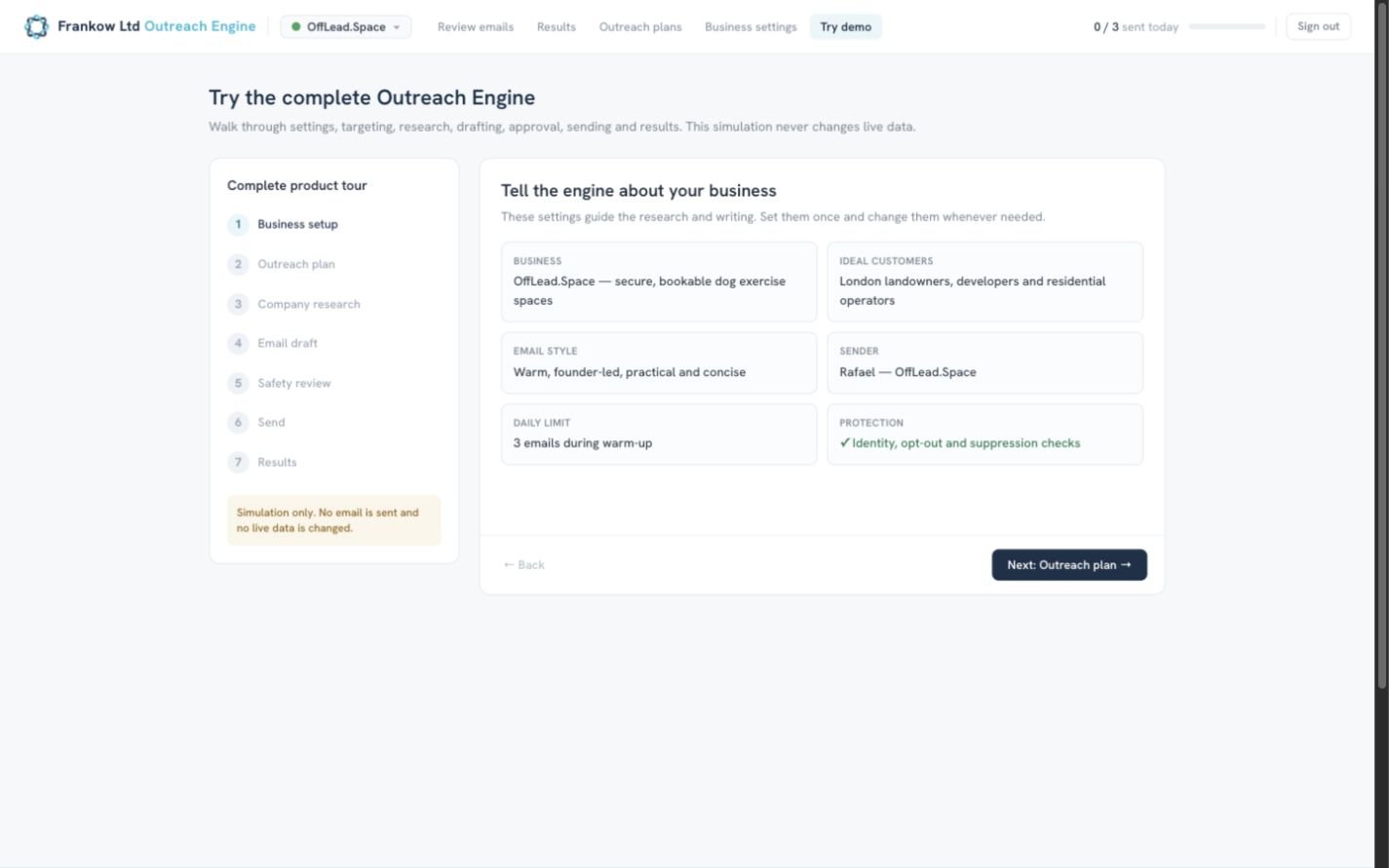
The reusable business profile gives research and drafting the context they need.
What the finished system connects
The application brings the full outreach workflow into one place:
- AI-assisted company research and qualification to assess fit before outreach
- Vibe Prospecting lead and contact data to support targeted discovery
- Supabase as the structured source of truth for companies, campaigns, drafts, suppression and results
- Zoho CRM to keep commercial records connected to the wider sales process
- Zoho Mail for controlled sending from the appropriate business identity
- Vercel for a secure, accessible operator interface
- Claude and OpenAI-assisted development to help design, build, test and improve the product
- A campaign dashboard showing activity, cost, replies and commercial progress
The technology matters, but the value comes from how the parts work together. Research without a decision process creates more reading. Contact data without qualification creates larger lists. Email generation without approval creates risk. A dashboard without clear commercial questions creates reporting rather than insight.
Why I kept people in control
The engine is deliberately human-controlled.
A discovered company must be approved before it becomes an active lead. A suggested contact must be confirmed. The message must be reviewed before it can be sent. Suppression and opt-out rules apply across the system.
This is not friction added after the build. It is part of the product design.
Cold outreach involves reputation, personal data and real relationships. A confident AI draft may still use weak evidence, choose the wrong recipient or make a promise the sender should not make. The system therefore uses AI for preparation while keeping accountability with the operator.
It was designed around UK GDPR and PECR safeguards, including source tracking, corporate-recipient confirmation, clear sender identity, conservative sending limits, suppression and opt-out controls. Technology can enforce good operating rules, although it does not replace appropriate legal judgement.
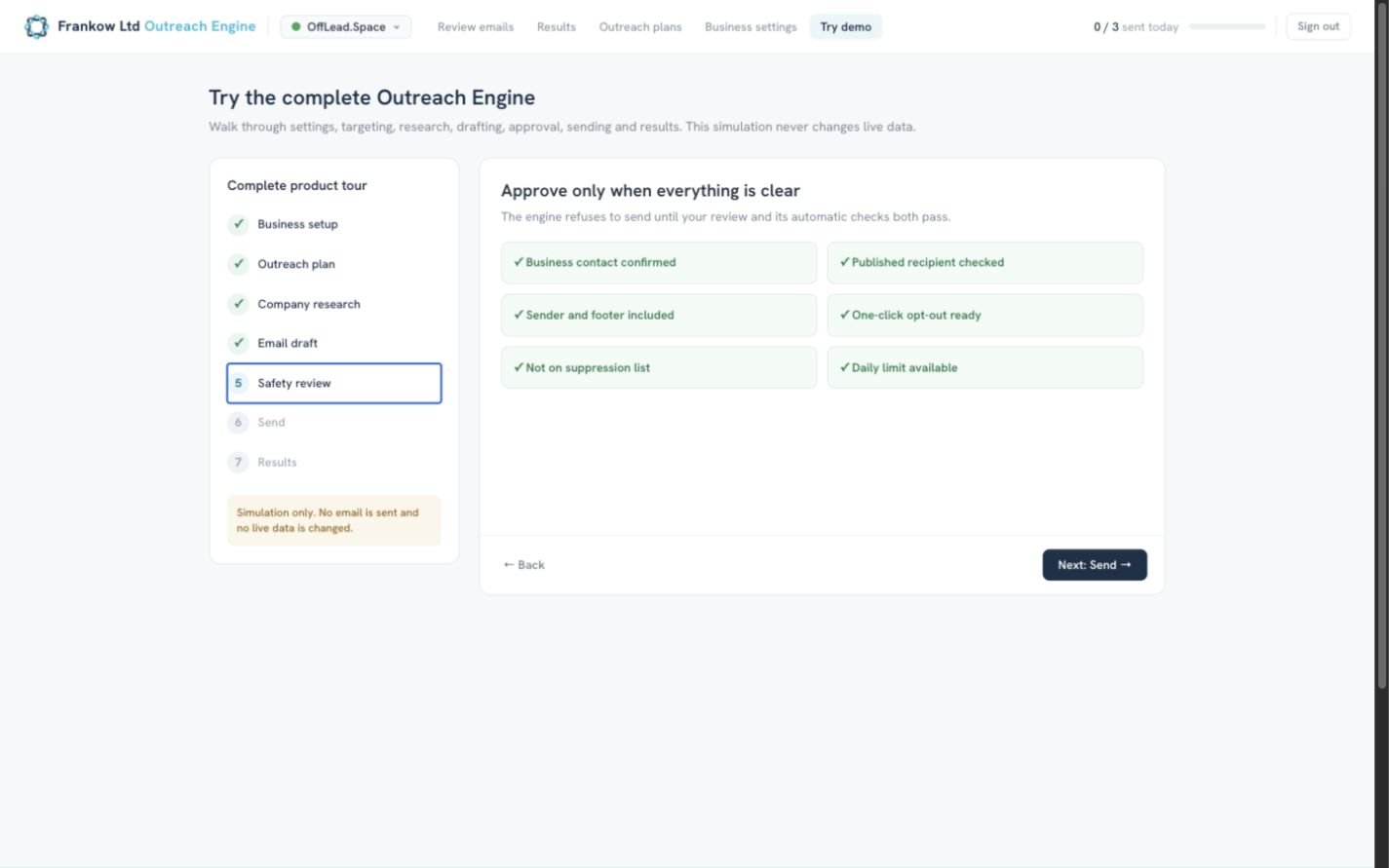
The system refuses to send until human review and its automatic checks both pass.
What I learned building it
The workflow matters more than the prompt
A better prompt can improve one email. A better workflow improves how every company is selected, researched, approved and tracked.
Domain knowledge is the specification
AI coding tools are most powerful when the operator can explain the real process, define quality and recognise a bad result. My advantage was not knowing every programming language. It was knowing how commercial research and outreach should work.
Human review is a feature
Full automation sounds impressive until the system contacts the wrong person or sends a weak claim. Review gates make the engine more trustworthy and more useful for relationship-led business development.
Data quality often matters more than generation
Writing is cheap. Reliable company information, the correct corporate email domain and a relevant decision-maker are harder. Automating poor data only creates poor outreach faster.
Documentation makes AI development scalable
When several AI tools help build a product, written decisions, architecture rules and current-state notes become essential. They prevent each new session from making a different assumption or quietly reversing an important safeguard.
A reusable system is more valuable than a one-off automation
OffLead.Space was the first use case, not the limit of the product. Separating the core engine from each business profile makes the same research, qualification and approval process usable across different ventures and client projects.
What this changed in my work
Building the Outreach Engine changed how I think about AI in commercial roles.
AI is not only a faster way to write. It gives an experienced operator the ability to create the tools, workflows and dashboards that previously required a larger internal team or a long software project.
For me, being an AI specialist does not mean presenting every problem as a prompt. It means understanding a business process deeply enough to decide where AI belongs, connecting the right data and tools, and designing controls that make the result dependable.
That does not make experience less important. It makes experience more executable.
I can now move from an idea about how market research or outreach should work to a functioning system, test it on a real business and improve it from evidence. The same approach supports competitor research, channel planning, account prioritisation and commercial dashboards.
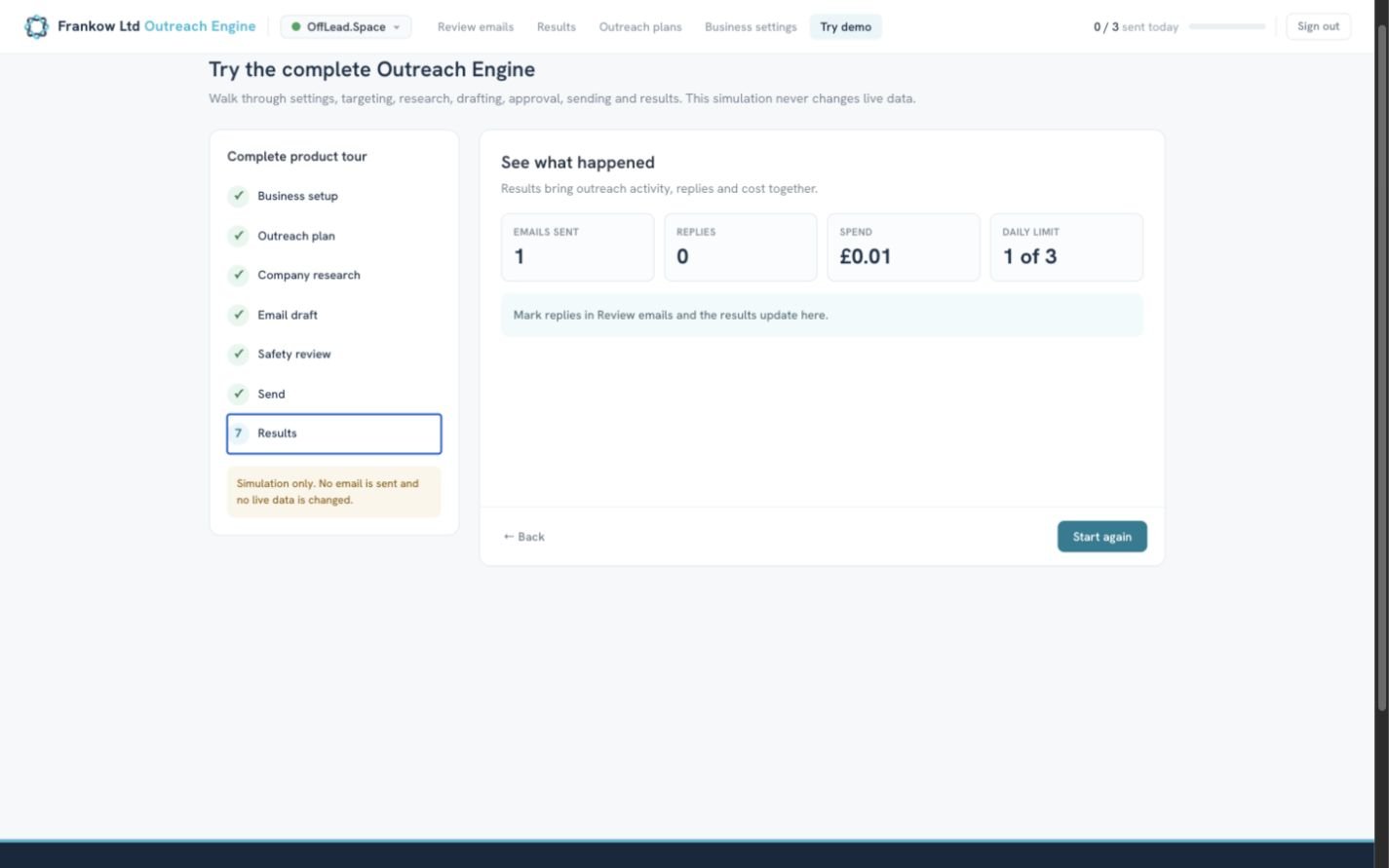
Activity, replies, cost and sending limits remain visible in one campaign view.
I explore the wider principle in Beyond automation: scaling knowledge work with AI deputies. The rule is consistent: let AI handle repeatable preparation, work with it where judgement improves the result, and keep control of the decisions that depend on trust.
The result is not outreach without people. It is a small commercial operation working with better preparation, stronger context and more capacity.
You can view the working AI Outreach Engine.
Frequently asked questions
Can a non-developer build an AI-powered business tool?
Yes, but AI coding tools do not remove the need for clear requirements, commercial judgement, testing and security controls. I used them to translate a workflow I understood into software, while reviewing how the system behaved at every important stage.
How does an AI-assisted B2B outreach engine work?
The system finds or imports suitable companies, researches and qualifies them, identifies an appropriate corporate contact, drafts a relevant email, requires human approval before sending, and records activity and results in one campaign view.
Is AI sales outreach fully automated?
Mine is deliberately not fully automated. AI handles time-consuming preparation, but a person approves the company, recipient and message before anything is sent. Relationships, claims and commercial judgement remain under human control.
How can AI outreach be designed around UK GDPR and PECR?
The workflow can include source records, corporate-recipient confirmation, suppression lists, clear sender identity, opt-out controls, conservative sending limits and human approval. These safeguards support responsible operation but do not replace appropriate legal advice.